MWCD Celebrates 15 Years of its Partners in Watershed Management Grants Program

Over $10 million in Grants Have Gone to 156 Projects in 18 Counties

$1,305,707 in New Grants Approved to Help Prevent Flooding and Improve Water Quality

This year, the Muskingum Watershed Conservancy District (MWCD) is celebrating the 15th anniversary of its Partners in Watershed Management (PWM) grants program by awarding $1,305,707 in new grants to 11 projects that will support flood mitigation and water quality improvement and conservation across Eastern Ohio.

“Eastern Ohio is blessed with talented, committed professionals and organizations that share a common mission: preserving and managing the Muskingum River watershed to protect life, property and our natural resources. For 15 years, MWCD has shared its resources with dozens of these organizations to invest over $10 million in strategic efforts to both reduce flooding and drive conservation. They have made a difference, and we look forward to another 15 years—and more—of working together,” said MWCD Executive Director Craig Butler.

Since its inception in 2009, PWM has provided over $10.7 million in grant funding for 156 projects in 18 counties across the Muskingum River watershed, the largest watershed contained entirely within Ohio and a watershed covering almost a third of the state. The program is highly competitive with a multi-step review process to ensure that highly effective projects receive grant dollars.  All applications are reviewed by MWCD staff and a select group of volunteer industry experts prior to the Chief Engineer and Chief of Conservation recommending applications for approval to the Executive Director and the Board of Directors.

Here’s what others are saying about PWM and its 15th anniversary:

“We have received three impactful PWM Grants over the last several years and are so grateful for the partnership with MWCD. The first funded our Aquatic Education Trailer, teaching water quality through a visual contrast of healthy and polluted streams. Since 2011, hundreds of students have benefited. The second grant supported water testing in farm tile drainage, leading some farmers to reduce fertilizer use without impacting yield. The latest grant funds our ‘Grow Native’ project, providing a small no-till drill to help landowners establish pollinator habitats.” – Lisa Crock, district administrator, Muskingum Soil and Water Conservation District.


“The PWM Grant Program has been an instrumental part of maintaining and improving water quality in the Muskingum River.  Rural Action has received eight PWM grants since the program began, which has supported everything from outreach and education, to research on endangered species. The most exciting outcome of one of our projects was when the first reintroduced eastern hellbender to have ever been found reproducing in the wild, was discovered in a nest box that was installed with PWM funding. We are so thankful for the support.” – Nate Schlater, senior director of ecological restoration, Rural Action.

“The support from MWCD’s PWM grant program was instrumental in advancing our flood mapping efforts in collaboration with the U.S. Army Corps of Engineers and the USGS. This funding allowed us to gain critical data and insights that helped us better protect our community from flood risks and plan for a more resilient future. We are grateful for MWCD’s commitment to improving watershed management across the region.” –Bobbie Beshara, city manager, City of Rittman.

A student explores the aquatic education trailer
Nutrient monitoring is conducted in the Walhonding River
First hellbender to be found reproducing and released


This year’s projects are:


APPLICANT COUNTY PROJECT TITLE DESCRIPTION AMOUNT
Ashland County Park District Ashland Greentown Native American Preserve Acquire 58.4 acres of Black Fork riverbank habitat to protect native wildlife, high-quality meadow, forest, wetland areas, and historic Native American sites. $194,000
Buckeye Lake for Tomorrow Licking Buckeye Lake Water Quality Monitoring Expand water monitoring to canals and inlets to collect more data and enhance nutrient mitigation. $33,721
Carroll Soil and Water Conservation District Carroll Carroll SWCD Green Infrastructure Design Green infrastructure and architectural improvements to the HQ building to enhance usability and serve as a model for best practices. $21,850
Holmes County Health District Holmes Sewage Treatment System GIS Development Create an inventory of existing sewage treatment systems to facilitate permitting and inspections in pursuit of better water quality and public health. $95,000
Village of McConnelsville Morgan McConnel Run Stream Project Restore and stabilize McConnel Run Stream in the Village of McConnelsville to enhance floodplain control and allow for redevelopment of the adjacent property.  


$150,472

Muskingum Soil and Water Conservation District Muskingum Grow Native Purchase a mobile seed drill to assist removal of invasive plants by replacing them with native species in small or hard-to-access areas.  


$25,760

Natural Areas Land Conservancy Summit Clinton Wetlands Preserve Acquire 19.17 acres of wetlands in Village of Clinton and help protect Tuscarawas River water quality. $114,551
Noble County Engineer Noble Noble Local School District Flood Reduction Mitigation efforts to reduce flooding impact to buildings and bus routes and can force school closures. $156,945
Stillwater Watershed Partners Harrison Milacik Log Jam Removal Remove current log jam that is impeding Stillwater Creek natural watercourse and flow $321,039
Tuscarawas Soil and Water Conservation District Tuscarawas Village of Baltic Streambank Stabilization Stabilize 500 ft of streambank in Village of Baltic along Brush Run Creek to protect against soil erosion and preserve water quality. $156,869
West Creek Conservancy Richland Clear Fork Mohican River Wetland Restoration Project Restore 62-acre property with riverfront forest and wetlands to mitigate downstream flooding and protect water quality in the Clear Fork Mohican River. $35,500
TOTAL $1,305,707

Organizations interested in future rounds of funding are encouraged to contact MWCD to discuss their projects at least 30 days prior to the application deadline of September 1, 2025, to learn more about the application process and have their applications preliminarily screened for eligibility.  Please contact Lynn Gilland, Administrative Specialist at 330-556-4817 or by email at [email protected].  Further information about the PWM program can be found at www.MWCD.org.

Ashland – Idlewood Cottage Area Roadway Improvements

The Ohio Department of Transportation in coordination with the Muskingum Watershed Conservancy District (MWCD) is planning improvements to the roadways within the Idlewood Cottage area at Pleasant Hill Lake.   These roads include Shoreline Drive, Maplewood Lane, Edgewood Road, Forest Hill Road, Oak Lane and Pine Ridge Lane.  The work to be completed includes localized partial depth pavement repairs and asphalt overlay.

Construction is scheduled to begin after May 4, 2026, and be completed by August 7, 2026. Right-of-way acquisition will not be required for this project. Traffic will be maintained during construction following ODOT Standard Construction Drawings.

Comments may be submitted to MWCD by email at [email protected] or dropped off or mailed to the following address:
Chief of Engineering, MWCD
2050 Reiser Ave. SE, New Philadelphia, OH 44663.

Comment submission will be accepted through April 6, 2025.

Should you have questions about the project, you can call at 234-801-7025 or by email at [email protected].

Funding available for projects advancing conservation, environmental stewardship

Applications open for research, community and innovation grants as well as fellowships

NELSONVILLE, Ohio – The Foundation for Appalachian Ohio (FAO), through its Environmental Stewardship Pillar of Prosperity, announces new funding opportunities to advance conservation, environmental stewardship and the greater well-being of Appalachian Ohio.

Thanks to a transformative $5 million investment from the Muskingum Watershed Conservancy District (MWCD), funding is available to support community projects, scholarships, fellowships, research and innovation in the areas of conservation and environmental stewardship.

“We’re grateful to the Muskingum Watershed Conservancy District for its game-changing investment in our region’s permanent capacity to advance conservation and environmental stewardship,” said Cara Dingus Brook, FAO president and CEO. “MWCD’s gift is the largest environmental stewardship endowment the Foundation has received to date, and it represents a significant investment in the well-being of our people and communities.”


In addition to giving financially, MWCD will also lend its deep expertise in the areas of environmental stewardship and conservation.

“We believe that partnerships between groups are crucial to advancing sustainability and environmental stewardship in Appalachia,” said Craig Butler, MWCD executive director. “By working together, we can leverage our collective resources and expertise to create a more significant impact and support a diverse range of projects and initiatives, from local community efforts to large-scale research and innovation.”

A total of $125,000 in grant funding is available within the 32 counties of Appalachian Ohio and seven additional counties served by MWCD. It’s possible because of MWCD’s gift – and other gifts from generous donors who helped to establish FAO’s Environmental Stewardship Pillar of Prosperity Fund, including Nicolozakes Trucking & Construction Inc., Ohio CAT and American Electric Power.

Available opportunities:

  • Community grants to support locally driven projects that preserve and enhance our natural environment. Public and nonprofit organizations as well as individuals or groups working with a fiscal sponsor are eligible to apply.
  • Scholarships to support individuals seeking degrees or continuing education in ecology, forestry, wildlife ecology or related natural resource fields, as well as skilled trades, vocational and technical training in fields that integrate and support green energy technology, sustainable agriculture and land stewardship.
  • Fellowships to provide two years of support (including a financial stipend and mentorship) for individuals who pioneer positive change through projects that address environmental challenges and promote biodiversity conservation.
  • Innovation grants to invest in new and creative approaches that result in environmental good while encouraging environmental stewardship.
  • Research grants to support studies that address critical gaps in our understanding of our diverse ecosystems and contribute to the conservation and enhancement of aquatic biodiversity and healthy habitats.

Additional information and funding applications are available at www.AppalachianOhio.org/EnvironmentalStewardship.

FAO’s Environmental Stewardship Pillar of Prosperity brings donors and doers together to ensure the people of Appalachian Ohio can experience our region’s natural beauty, both today and for generations to come. To date, the Environmental Stewardship Pillar has invested more than $1.6 million in grants and scholarships throughout Appalachian Ohio.

For more information on these funding opportunities and how you can support or create opportunities for the people and communities of Appalachian Ohio, visit www.AppalachianOhio.org, email [email protected] or call 740.753.1111.

About the Foundation for Appalachian Ohio

The Foundation for Appalachian Ohio is a regional community foundation serving the 32 counties of Appalachian Ohio. A 501(c)(3) public charity, the Foundation creates opportunities for Appalachian Ohio’s people and communities by inspiring and supporting philanthropy. For more information, visit www.AppalachianOhio.org and follow FAO on Facebook and Instagram.

MWCD is seeking public input regarding designation of the final major tributary within the Muskingum Watershed, the Walhonding River

NEW PHILADELPHIA, OHIO The Muskingum River Watershed provides hundreds of miles of picturesque rivers and streams that are home to many Ohioans’ favorite paddling getaways. The watershed includes major tributaries such as the Mohican, Kokosing, Tuscarawas, Muskingum, and Walhonding Rivers. Four of these rivers – the Mohican, Kokosing, Tuscarawas and Muskingum – are designated state Water Trails by the Ohio Department of Natural Resources (ODNR), providing paddling access, safety resources, and essential amenities to outdoor enthusiast.

The Muskingum Watershed Conservancy District (MWCD) is seeking public input regarding designation of the final major tributary within the Muskingum Watershed, the Walhonding River. This 23.5-mile long river is formed by the confluence of the Mohican and Kokosing Rivers. After flowing through Coshocton County, it joins the Tuscarawas River, near the City of Coshocton, creating the Muskingum River.

A public meeting will be held on January 28, 2025, at 5:30PM at the Coshocton County Commissioners’ Community Building (637 Chestnut St. Coshocton, Ohio 43812). The information gathered will assist the designation process, which will involve the partnership of many agencies, including organizations providing information and land management. For those unable to attend the meeting, a short survey can be completed at www.MWCD.org/WalhondingRiver. The Water Trail designation program is administered by ODNR Division of Parks and Watercraft. Partnering agencies include:

  • MWCD
  • US Army Corps of Engineers
  • ODNR – Division of Wildlife, Parks and Watercraft
  • City of Coshocton
  • Coshocton County Park District
  • Knox County Park District
  • Village of Warsaw
  • Village of Nellie
  • Roscoe Village Foundation
  • Friends of the Coshocton County Parks
  • Coshocton County Commissioners & Engineers
  • Coshocton Port Authority
  • Our Town Coshocton
  • Coshocton CVB
  • Coshocton Chamber of Commerce

The Walhonding River is special to those who live in the communities around it and the partners hope to share it with paddlers around Ohio and surrounding states to improve awareness of paddling opportunities in the region. This region provides pristine natural landscapes and quiet stretches of nature, perfect for a relaxing trip on the river with opportunities to spot local wildlife and enjoy breathtaking views. If designated, the Walhonding River will join the Muskingum Watershed system of water trails, which would create a designated riverway system totaling over 300 miles.

“Embarking on a kayaking adventure down the Walhonding River is an opportunity to immerse yourself in Ohio’s natural beauty. Each moment spent on the river offers a unique connection to the environment and an unforgettable experience for paddlers of all skill levels”, said Craig Butler, Executive Director for MWCD. “We look forward to being able to share this hidden gem with paddlers across the region!”

Western Reserve Land Conservancy and MWCD Partnership Conserved Over 3,990 Acres in Coshocton County Since 2020

Land preserved in perpetuity through conservation collaboration.

(Coshocton County, OH) — December 17, 2024 — In multiple stages over five years, Western Reserve Land Conservancy and Muskingum Watershed Conservancy District (MWCD) have forever protected over 3,990 acres in Coshocton County. The land is now owned by MWCD. Starting with the 1,827-acre Coshocton Forest acquisition in January 2020, these efforts continued with acquiring the 933-acre Coshocton Forest Extension in December 2021 and the 609-acre Turkey Ridge Preserve in November 2023. Most recently, the 622-acre Turkey Creek Preserve acquisition was finalized in August 2024.

Located in the Muskingum River Watershed, the conserved properties span a reclaimed coal mining area and boast successional hardwood forests, old field habitat, almost 400 acres of sprawling ponds and high-quality wetlands, and over 50,000 linear feet of streams. More than 450 plant and animal species call the properties home, including several rare and state-listed species. An Ohio endangered moss and two Ohio endangered bat species have been documented as well.

In addition to preserving these natural spaces, these projects also conserved a significant portion of publicly accessible recreation land. MWCD will manage these properties in conjunction with the Ohio Department of Natural Resources (ODNR), which owns two large preserves within seven miles of the property, including the 14,615-acre Woodbury Wildlife Area and the 844-acre SIMCO Wildlife Area. Hiking, hunting, fishing, mountain biking, and other passive outdoor recreation activities will be allowed on the property.

Previously, the land was owned by Ohio Franklin Realty, a subsidiary of American Electric Power (AEP). After mining activity ended in the mid-1900s, ODNR managed much of the area for public access as a component of the AEP public ReCreation Land. The conserved area contributes to an approximately 9,600-acre corridor of protected land owned by MWCD in Coshocton County. Applications for additional funding are underway for Phase V of the project, which will help connect the corridor to SIMCO Wildlife Area.

Together, the Land Conservancy and MWCD submitted four successful funding applications to the Clean Ohio Green Space Conservation Fund through the Ohio Public Works Commission (OPWC). As a result, $10.4 million was awarded for the acquisition of these properties, which are permanently protected by Clean Ohio deed restrictions.

“MWCD is proud to partner with the Western Reserve Land Conservancy and other organizations to protect these vital natural areas,” said Craig Butler, MWCD Executive Director.  “We are dedicated to keeping the lands open for public use while also planning to enhance areas to improve recreational experiences. This collaboration ensures these spaces serve both the environment and the community for generations to come.”

“Conservation at this scale doesn’t happen without partnership,” said Hannah Kelling, southwest field director at the Land Conservancy. “Of course, conservation at its core is about human beings partnering with the natural world — recognizing our place in it, our responsibility to it, and our relationships within it. In this case, we have accomplished the conservation of thousands of acres together with MWCD and OPWC because they, too, have embodied this vision from the beginning and have devoted their resources to it. With their help, we are confident that these acres will provide a refuge for both humans and wildlife for decades to come.”

About Western Reserve Land Conservancy:

The nationally accredited Western Reserve Land Conservancy — the largest local land trust in Ohio — provides people throughout Ohio with essential natural assets through land conservation and restoration. To date, the Land Conservancy has permanently preserved 75,000 acres at more than 930 properties; helped create and expand 220 public parks and preserves; led the efforts to create 69 county land banks across Ohio; and planted and distributed more than 16,000 robust trees in Cleveland. For more information, visit wrlandconservancy.org.

About Muskingum Watershed Conservancy District:

The MWCD, a political subdivision of the state, was organized in 1933 to develop and implement a plan to reduce flooding and conserve water for beneficial public uses in the Muskingum River Watershed, the largest wholly contained watershed in Ohio. Since their construction, the 16 reservoirs and dams in the MWCD region have been credited for saving over $8 billion worth of potential property damage from flooding according to the federal government, as well as providing popular recreational opportunities that bolster the region’s economy, garnering more than 5 million visitors annually. A significant portion of the reservoirs are managed by the MWCD, and the dams are managed for flood-risk management by the federal U.S. Army Corps of Engineers (USACE). For more information about the MWCD, visit www.mwcd.org and follow the MWCD on Facebook, Instagram, and X.

New Amenities Coming to Tappan Lake Park Including a Pump Track in 2025

The Muskingum Watershed Conservancy District is excited to announce the installation of a brand-new pump track, set to open in Spring 2025 at Tappan Lake Park. This new addition will cater to outdoor enthusiasts of all ages and skill levels, offering a fun, challenging, and safe environment for biking, skateboarding, rollerblading, and scootering. The pump track will be located near the park’s popular swim beach, with easy access to other amenities, including scenic hiking trails and picnic areas.

This new track is part of the park’s ongoing commitment to expand recreational offerings and provide exciting outdoor activities for both residents and park visitors. A pump track is a circular trail designed with a series of rollers, banked turns, and smooth terrain, allowing riders to navigate the course without pedaling, using body movements to maintain momentum. Riders of all skill levels – from beginners to experienced athletes – will enjoy this thrilling addition.

“We’re thrilled to offer a new outdoor attraction that encourages active recreation for individuals and families,” said Pete Novotny, MWCD Chief of Recreation. “The pump track is designed to be inclusive, so whether you’re new to riding or an experienced pro, you’ll find something exciting and challenging.”

Along with the pump track, additional amenities are planned at the park entrance to complement the recently opened Welcome Center including a new shelter and firepit area perfect for gatherings and events, along with scenic walking paths through wildflowers. For guests seeking active recreation, the area will feature a variety of new amenities: a basketball court, two pickleball courts, and outdoor lawn games like concrete corn hole and table tennis. Additionally, a dedicated gaga ball area invites group play for visitors of all ages. A new playground will further enhance family-friendly activities, complete with climbing rocks, swings, creative play structures, and shaded seating areas to relax and enjoy the natural surroundings.

A ribbon-cutting ceremony is planned for the grand opening in Spring 2025, with activities and events to be announced closer to the date. Tappan Lake Park invites the community to stay tuned for updates and to visit the park year-round for a variety of recreational activities.

For more information about the new pump track or other park amenities, visit www.mwcd.org.

MWCD Awards $63,000 to Improve Water Quality

The Muskingum Watershed Conservancy District (MWCD) is pleased to announce the awarding of $63,000 to five regional conservation organizations for the development of nonpoint source implementation strategies (NPS-IS) within the Muskingum River Watershed. These strategies will address environmental impairments and improve water quality across critical areas of the watershed, supporting local conservation efforts that benefit both the environment and the communities within the region.

Awardees include:

  • Ashland Soil & Water Conservation District
  • Holmes Soil & Water Conservation District
  • Rural Action
  • Summit County Engineers Office – Surface Water Management District
  • West Creek Conservancy

These organizations will use the funds to develop NPS-IS plans, which are essential tools for identifying and addressing environmental issues in specific areas. By grounding these strategies in sound science, the plans create a roadmap for improving the environment while also unlocking state and federal funding opportunities. These plans open the door to more substantial funding through the Ohio Environmental Protection Agency’s 319 grant program, enabling further investment in conservation projects ranging from streambank restoration to the implementation of green infrastructure.

The awarded plans will focus on critical subwatersheds within the Muskingum River Watershed, which spans multiple counties and key tributaries, including Killbuck Creek, Black Fork and Clear Fork Mohican River, Stillwater Creek, and the Tuscarawas River. In total, these efforts will cover areas of Ashland, Coshocton, Harrison, Holmes, Knox, Marrow, Portage, Richland, Stark, and Summit counties, consuming 133,548 acres, and serving an estimated population of 54,470 residents.

NPS-IS plans are vital for addressing nonpoint source pollution—pollutants that come from diffuse sources such as runoff from agricultural fields or urban areas. They identify specific environmental issues within a watershed, set goals for improvement, and outline practical, scientifically based conservation strategies. With these strategies in place, communities can secure funding for projects that directly improve water quality and environmental health.

“We are committed to improving water quality and addressing environmental impairments in the Muskingum River Watershed,” said Matt Thomas, MWCD Chief of Conservation. “These grants help build the foundation for long-term conservation efforts, and by supporting the creation of these NPS-IS plans, we are helping local communities unlock further funding opportunities and achieve lasting environmental benefits.”

The MWCD continues to support regional conservation organizations in their efforts to protect and improve the watershed’s natural resources, ensuring a healthy environment for generations to come.

MWCD Seeks Public Input to Develop Trail Master Plan

The Muskingum Watershed Conservancy District (MWCD) continues its commitment to providing outdoor recreation opportunities through its vast network of trails, emphasizing their critical role in promoting community well-being, conservation, and environmental education.

The MWCD trail system offers a wide variety of hiking, biking, and equestrian paths that meander through the scenic landscapes of the Muskingum River Watershed. These trails provide opportunities for individuals and families to connect with nature, stay active, and explore Ohio’s rich natural heritage.

MWCD is committed to expanding and improving its trail network to meet the growing demand for outdoor recreational opportunities. As part of this effort, MWCD is seeking community input to develop a Master Trail Plan that will guide the enhancement and expansion of the trail system in the years ahead.

“We believe that trails are essential to the health and vitality of our communities,” said Pete Novotny, MWCD Chief of Recreation. “They offer more than just outdoor fun—they connect people to nature, improve our quality of life, and foster a greater appreciation for conservation.”

For more information about MWCD’s trails or to participate in the ongoing survey to shape future trail development, visit www.mwcd.org. (UPDATE – this survey has closed)

Your participation will help guide the MWCD’s efforts in planning and expanding the trail network in the coming years. Together, we can ensure that our trails continue to be a valuable resource for outdoor enthusiasts.

MWCD Winter Drawdown Schedule and Reservoir Projects Released

The Muskingum Watershed Conservancy District (MWCD) has announced its winter drawdown schedule, an essential annual operation that supports flood control and reservoir maintenance throughout the region. While MWCD lakes attract millions of visitors each year for activities like fishing, boating, camping, and hiking, their primary role is to help protect the Muskingum Watershed from flooding.

Each winter, the U.S. Army Corps of Engineers (USACE) lowers the lake levels temporarily to provide increased flood storage for winter snowmelt and spring rains. This controlled drawdown also allows MWCD staff to complete shoreline stabilization projects and other critical maintenance tasks. The drawdown will begin in early November, with water levels expected to return to normal by February, ensuring the lakes are fully prepared for the next summer season.

The temporary 2024 – 2025 drawdown dates and lake levels are as follows:

Reservoir Normal Pool Winter Level Total Drawdown (feet) Begin 2024 Drawdown Release Duration (days) Suggested intermediate refill schedule by 3/15/25
Atwood 928.00 920.00 8.0 November 15 42 926.00
Charles Mill 997.00 992.00 5.0 November 15 35 995.00
Clendening 898.00 893.00 5.0 November 15 35 896.00
Leesville 963.00 958.00 5.0 November 8 35 961.00
Piedmont 913.00 908.00 5.0 November 1 35 911.00
Pleasant Hill 1020.00 1012.00 8.0 November 1 42 1018.00
Seneca 832.20 824.20 8.0 November 1 42 830.20
Tappan 899.30 894.30 6.0 November 15 35 897.30
NOTE: Due to planned construction at Atwood, Charles Mill, and Seneca Lakes, and for USACE maintenance work at Pleasant Hill and Tappan, we request that additional drawdown occur to the elevations noted. All reservoirs with extended drawdown shall be held at the requested elevation until February 15, 2025, and then returned to the normal winter schedule elevations.

Shoreline projects planned for the Winter of 2024 – 2025 include:

  • Seneca Lake – A combination of rock riprap and soil lifts with native plantings will be utilized to stabilize a 270-foot long section of steeply eroded shoreline along SR147 near Grant Moore Road, and rock riprap / coir logs will be installed to stabilize approximately 670 feet of eroding shoreline within Seneca Lake Park.
  • Atwood Lake – A combination of rock riprap and soil nails will be utilized to stabilize the shoreline and a significant landslide that has occurred in the Area 4 Campground at Atwood Lake Park.  The landslide is approximately 250 feet in length, and the shoreline stabilization work will extend a total of 770 feet.


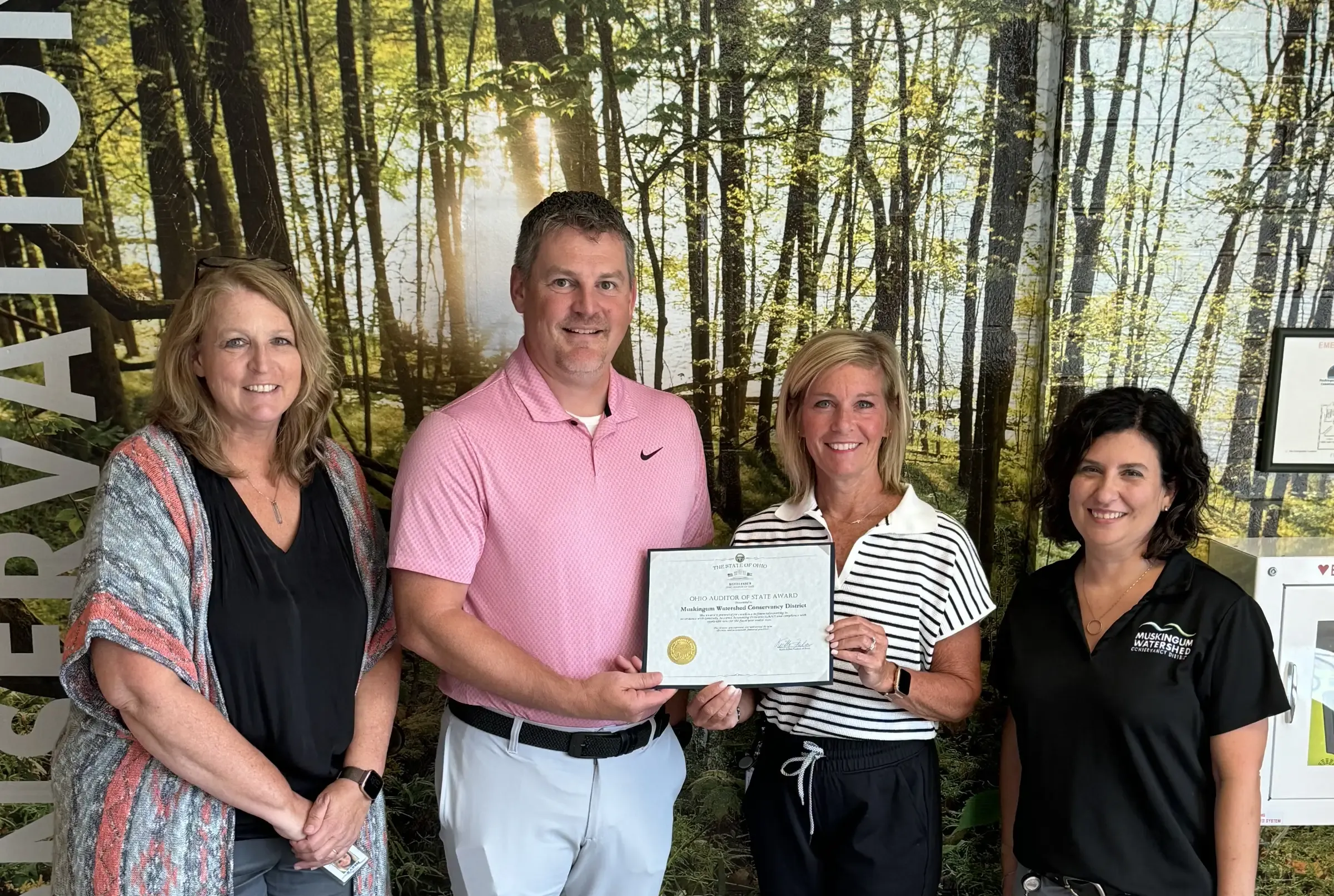
MWCD Receives Auditor of State Award for Clean Audit Report

New Philadelphia, OH (September 24, 2024)— The Muskingum Watershed Conservancy District (MWCD) has been awarded the ‘Auditor of State Award’ from the Ohio Auditor of State’s office for meeting a range of criteria for required audits conducted on the conservancy district’s financial records for the past year.

Auditor of State, Keith Faber recently announced that the MWCD was selected to receive the award of commendation because the MWCD audit report for the year 2023 met the following guidelines:

  • The entity must file financial reports with the Auditor of State’s Office by the statutory due date, without extension, via the Hinkle System on the GAAP accounting basis.
  • The audit report does not contain any findings for recovery, material citations, material weaknesses, significant deficiencies, Uniform Guidance (Single Audit) findings, or questioned costs.
  • The entity’s management letter contains no comments related to:
    • Ethics referrals
    • Questioned costs less than the threshold per Uniform Guidance
    • Lack of timely report submission
    • Bank reconciliation issues
    • Failure to obtain a timely Single Audit in accordance with Uniform Guidance
    • Findings for recovery less than $500
    • Public meetings or public records issues
  • The entity has no other financial or other concerns.

“MWCD is again proud to be recognized for financial management excellence by Auditor Farber,” said Craig Butler, MWCD Executive Director.  “This award represents the high level of commitment to financial stewardship of our excellent financial management staff and all MWCD employees.”


Copies of the MWCD’s audit reports are available online at the Auditor of State’s website at www.auditor.state.oh.us.

The Auditor of State’s office is responsible for auditing more than 5,900 state and local government agencies.

State Fire Marshal Orders Ban on Open Burning for Certain Ohio Regions

Columbus, Ohio – In response to extremely dry conditions in various areas of the state, Ohio Fire Marshal Kevin Reardon has ordered a regional Ban on Open Burning effective immediately. The ban impacts any county in Ohio identified by the National Oceanic and Atmospheric Administration (NOAA) or United States Department of Agriculture (USDA) as being in the “Extreme Drought” or “Exceptional Drought” categories as identified by the United States Drought Monitoring System.

The Burn on Open Burning ordered today, Sept. 6, 2024, includes the following Ohio counties: Athens, Belmont, Carroll, Fairfield, Fayette, Gallia, Guernsey, Harrison, Highland, Hocking, Jackson, Jefferson, Meigs, Monroe, Morgan, Muskingum, Perry, Pickaway, Pike, Ross, Scioto, Tuscarawas, Vinton, and Washington. Additional counties may be added upon designation of “Extreme Drought” or “Exceptional Drought” conditions issued by NOAA and/or the USDA within such counties or added by written directive of the State Fire Marshal.

Examples of outdoor activities prohibited by this order in the ban area include the following: lighting or maintaining an fire of any type at any location, smoking (including cigarettes or similar devices, and as part of a cooking process), non-electric cooking (regardless of fuel source), using or discharging any type of fireworks, throwing down/discarding lighted or smoldering material (including matches or cigarettes), campfires, bonfires, live fire training events, flame effect(s) based displays or exhibitions (including sky lanterns and cold spark machines), and using spark causing devices for recreational purposes.

Pursuant to Ohio Revised Code (R.C.) §3737.82R.C. §3737.22(A)(1) and R.C. 3737.22(A)(2), and Ohio Administrative Code (OAC) 1301:7-7-03(G)(1)(b), Ohio Fire Code (OFC) 307.1.2, the Division of State Fire Marshal issues the following Ban on Open Burning Order.

Click here to access the order.

“Fire safety is a responsibility we all share,” said Ohio State Fire Marshal Kevin Reardon. “It’s critical that Ohioans understand and appreciate the significant risks associated with fires, especially during the current drought conditions. Together we can protect our communities and environment.”

The Ohio Department of Commerce’s Division of State Fire Marshal, Ohio Department of Natural Resources (ODNR) Division of Forestry, and the Wayne National Forest urge all Ohioans to take special precautions due to the dry weather, whether they are in a county impacted by the Ban on Open Burning or not.

“All Ohioans, particularly homeowners, farmers, and woodland owners, should be cautious during this dry period,” said ODNR Division of Forestry Fire Prevention Manager Aaron Kloss. “Most of the plant materials in Ohio that can fuel wildfires are currently dry and will stay this way until we have significant rainfall. Current dry weather patterns with warm temperatures, low humidities, and wind are increasing the risk of wildland fires in Ohio.”

Dry grasses, shrubs, dead leaves, and fallen pine needles are all examples of plant materials that can fuel wildfires. Even if rain is in the forecast, it will require an extended period of soaking rains to reduce the elevated threat of wildfires throughout the state. Spring and fall are the typical wildfire seasons in Ohio; however, the current weather situation and resulting wildfire fuel situation is not typical. Warm, dry windy days in the fall, combined with abundant dead leaves falling and herbaceous plants entering dormancy and drying out, typically create situations conducive to wildfire igniting and spreading.

“Familiar things like vehicle exhaust pipes or an unattended campfire could quickly ignite dry fuels,” said Wayne National Forest Supervisor Lee Stewart. “We’re asking the public to be careful with outdoor fire. If you’re outdoors this season, please be observant and report smoke or flames to emergency authorities right away. Our fire and law enforcement personnel are ready to serve and respond when needed.”

Residents can take measures to prevent accidental wildfires including, avoiding burning trash and debris, keeping grass trimmed, not discarding cigarettes and other smoking materials outside, postponing fireworks, and avoiding open cooking fires or campfires. Additionally, farmers should regularly check their equipment for any irregularities that can lead to a brush or crop field fire.

Anyone who sees any signs of wildfire should call their local fire department immediately to report it. Accurate and timely reporting of wildfire responses by Ohio fire departments is important for a rapid response to the incident.

###

The Division of State Fire Marshal is part of the Ohio Department of Commerce. The department is Ohio’s chief regulatory agency, focused on promoting prosperity and protecting what matters most to Ohioans. We ensure businesses follow the laws that help them create jobs and keep Ohioans safe. To learn more about what we do, visit our website at com.ohio.gov

MWCD Launches Ranger Call Center for Non-Emergency Issues

The Muskingum Watershed Conservancy District (MWCD) is launching a new 24-hour call center for visitors to contact MWCD Rangers and seek assistance with non-emergency issues. The call center number, 844-MWCD-LAW (844-692-3529), will be available starting September 6, 2024. Emergency, life-threatening issues should still be directed to 911.

“MWCD Rangers are sworn peace officers with full police powers, dedicated to ensuring the safety and well-being of our visitors and the preservation of our natural resources,” said Craig Butler, Executive Director of the MWCD. “This 24-hour call line is another way we are enhancing our service to our visitors and providing a reliable resource for addressing non-emergency issues in a timely manner.”

The new call line is designed to address situations that require Ranger intervention, such as disturbances, suspicious activity, or issues related to park regulations. The calls will be answered by a call center and dispatched to a Ranger who will return the call as soon as possible.  While the Rangers are ready to assist with these matters, it is crucial that the public continue to dial 911 for all emergencies. Park, marina, and main office phone lines will continue to be answered as usual during business hours.

Chief Ranger Patrick Brockmeier emphasized the importance of this new service. “We want to make sure everyone has a safe and enjoyable experience at our lakes, parks, and marinas. This call line gives the public a simple and effective way to reach Rangers for help with issues that don’t rise to the level of an emergency but still need attention.”

The call line is part of the MWCD’s ongoing efforts to improve safety and communication throughout its parks and facilities. As always, the MWCD encourages all visitors to enjoy the beauty of Ohio’s natural resources responsibly and to report any issues to the appropriate authorities.

Subscribe

Please enable JavaScript in your browser to complete this form.
Name
I'm interested in information about: